Detecting your location...
SALE: UP TO 23% OFF LALLEMAND YEAST
Winemaking Category Header
Premium Winemaking Supplies

Craft Award-Winning Wine at Home

Everything you need to press, ferment, and bottle your own perfect vintage. From professional-grade tanks to guaranteed recipe kits, we make home winemaking easy and delicious.

  • Premium Equipment: Top-tier Speidel bladder presses and Enoitalia crushers built to last.
  • 100+ Recipe Kits: Brew high-quality, delicious wine easily at any time of the year.
  • Dozens of Yeasts: Dial in your exact flavor, aroma, and body profiles with precision.
  • Expert Guidance: Access our free guides to master red and white winemaking techniques.
1

Prep & Crush

Select your fresh juice, grapes, or one of our 100+ premium recipe kits to get started.

2

Ferment

Pitch the perfect specialized yeast to build your ideal flavor, aroma, and body profile.

3

Bottle & Enjoy

Follow our expert guides to age your wine to perfection, then pop the cork and share.

Shop by collection
1020 products

  • Hydrometer - Brix (10 - 20) With Correction Scale Hydrometer - Brix (10 - 20) With Correction Scale

    Brix Hydrometer (10 to 20) With Correction Scale

    Precise hydrometer for measuring the sugar content and progress of fermentation in wine ferments. Comes with a thermometer/correction scale built-in. 15" total length. Please Note: Due to the large size of this hydrometer, it does not work with our standard 11" or 14" hydrometer jars. We recommend using our 500mL Graduated Cylinder with this hydrometer.

    $30.99

  • Sale -2% Milwaukee MW151 MAX pH/ORP/Temp Logging Bench Meter (Milwaukee# MW151US) Milwaukee MW151 MAX pH/ORP/Temp Logging Bench Meter (Milwaukee# MW151US)

    Milwaukee MW151 MAX pH/ORP/Temp Logging Bench Meter

    The Milwaukee MW151 MAX 3-in-1 PRO pH/ORP/Temp Bench Logging Meter is preferred by people testing all types of samples viscus or not, in a variety of applications that cause other pH meters and electrodes to fail.  The logging feature allows log-on-demand and log-on-stability features that ensure all readings are accurate and not entered incorrectly. The MA917B/1 Milwaukee double junction electode is refillable and easy to clean.  From brewers and wine makers to hydroponic growers, labs and water treatment, the MW151 MAX is your Bench Logging Meter for fast, accurate readings. Accuracy People choose the MW151 MAX 3-in-1 PRO pH/ORP/Temp Portable Logging Meter to improve the accuracy of their testing program. With up to 5 point calibration and 7 standard buffer choices (2 custom buffers also), the meter can be quickly calibrated to a higher accuracy compared with one or two point calibration. The MW151 MAX meter is accurate to ± 0.002 pH. 8 x more accurate than some alternative meters. The meter comes with a refillable, glass, double junction pH electrode and MA831R temperature sensor allowing the meter to automatically adjust the pH reading for the effect of temperature (ATC). The meter can also be used as a very accurate thermometer with accuracy +/-0.4°C (+/-0.8°F). Low Maitenance The MW151 MAX pH/OPR/Temp Bench Logging Meter comes with the Milwaukee glass, double junction MA917B/1 pH electrode. This is Milwaukee's top selling lab grade electrode for a reason. Designed to be both low maintenance (refillable) and able to withstand more challenging samples (double junction). The MA917B/1 is ideal for use in beer making, winemaking, hydroponics, laboratories and many other applications.  Features: Fast easy-to-read results with large duel level digital LCD readout. Extreme accuracy to ±0.002 pH | +/- 1 mV OPR | +/- 0.4°C (+/-0.8°F).  Extended pH range (-2.00 pH to 20.00 pH / -2.000 to 20.000 pH). Lightweight, sleek design with small benchtop footprint. Simple easy-to-use logging and USB download functions, manual or on stability up to 1,000 logs. Electrode diagnostics feature checks and displays the condition of the pH electrode.  Easy measurement: just place the electode and temperature probe in the sample, gently stir and wait for the reading to stabilize. Simple push button, automatic up to 5 point calibration for increased accuracy. Up to 7 Standard calibration solutions (1.68, 4.01, 6.86,7.01, 9.18, 10.01 and 12.45) and 2 custom choices. Refillable, glass, double junction lab grade pH electrode for low maintenance and high performance with a screw on cap to ensure proper storage. Built-in rechargeable battery with 8 hours battery life (battery included). Selectable Auto-off feature.  Alphanumeric LCD display messages for friendly, intuitive information, warnings and error messages. Internal clock date to keep track of different time-dependent functions (calibration, timestamp,calibration time out). 3 feet probe cables for extra flexibility when testing. Care and Use pH meters usually start performing poorly because of problems with the probe. The two parts of the pH probe that cause problems are the glass sensing bulb and the reference junction. Sensing Bulb The glass bulb loses sensitivity with use and will eventually fail. This is true of all pH probes. Reference Junction The reference junction is a small hole that allows the meter to compare the sample to a reference. The reading is generated based on the electrical difference between the sample and reference. If the junction hole gets clogged, the pH electrode will no longer function. You can extend the life of your pH electrode in the following ways. Storage To minimize clogging the pH probe needs to be kept hydrated. Long periods of dry storage will damage the sensitivity of the probe. Allowing the probe to dry out may also result in the junction hole getting clogged. Storing in pH probe storage solution or pH calibration buffers will help address both these issues. Do not store in tap water and DI water. This will damage the sensitivity of the probe. The best way to store the probe is with the probe's cap filled with storage solution or calibration buffer and the cap tightened to prevent leakage. It is also recommended that to store the electrode upright to further reduce the potential for leakage. Cleaning and Maitenance Residue from the sample can impact the sensitivity of the sensing bulb and clog the junction. This is especially true if the sample has a lot of organic material. We recommend regularly soaking your electrode in cleaning solution. Also: Inspect the electotrode for damage or scratches, if present replace the electrode. Inspect the cable.  The connection cable and insulation must be intact. Connectors should be clean and dry. Rinse off salt deposits with water or DI water. Calibration The pH sensing bulbs become less sensitive over time so make sure that you are calibrating regularly to keep your PRO Plus pH meter accurate. Also, calibrate after cleaning or a long period of storage. Specifications: pH Range: -2.00 to 20.00 pH / -2.000 to 20.000 pH ORP Range: ±2000.0 mV Temp. Range: -20.0 to 120.00°C (-4.0 to 248.0°F) Resolution: 0.01 pH / .001 pH Resolution: 0.1mV Resolution: 0.1°C / 0.1°F) Accuracy: ±0.01 pH / ±0.002 pH @ 25°C / 77°F Accuracy: ±1mV Accuracy: ±0.4°C |±0.8°F pH Calibration: up to 5 point automatic pH calibration | 7 standard buffers (pH 1.68, 4.01, 6.86, 7.01, 9.18, 10.01, 12.45) and two custom buffers Temperature Compensation: Automatic, -20.0 to 120.0°C (-4.0 to 248.0°F) or manual pH electrode: MA917B/1 glass, double junction pH electrode (supplied) Temperature probe: MA831R (included) Logging: Maximum 1,000 samples (stored in up to 100 lots) / on demand, 200 samples on stability, 200 samples/ Interval logging, 1000 logs PC Connectivity: 1 USB Port, 1 micro USB port Power supply: 12VDC, 5 VDC USB Adapter (included) Battery life: Approx. 8 hours of use Auto-off: Selectable 5, 10, 30, 60 min. or off Environment: 0 to 50°C / 32 to 122°F; max RH 95% Dimensions: 230 x 160 x 95 mm (9.0 x 6.3 x 3.7 inches) Weight: 0.9 kg / 2.0 lbs.    

    $520.50 $510.09

  • Titrettor

    Titrettor

    4 reviews

    A plastic holder for the glass titrets.

    $10.99

  • Wine Kit - VineCo - Estate Series - Malbec, ARG Wine Kit - VineCo - Estate Series - Malbec, ARG

    Argentina Malbec Wine Making Kit - VineCo Estate Series™

    Malbec traces its origins, like so many others, to the Bordeaux region of France, where it descended from two enigmatic French grapes—Magdeleine Noire des Charentes and Prunelard. It is one of the five red grapes that can be blended to produce red Bordeaux, but in modern times it’s percentage in the blend has significantly decreased and sometimes commonly omitted entirely. This is due to the vine’s sensitivity to frost, which is not ideal in Bordeaux’s maritime climate. In its native region, Malbec plantings have been steadily declining for some time now. Varietal Malbec is celebrated for its soft mouthfeel, rich plum and earthy flavors, and alluring inky, dark color. Thank Dionysus that Malbec has taken root in another part of the world where it has absolutely thrived. Brought over to Argentina in the mid-19th century, the vines have flourished in the dry, sunny vineyards high in the Andes mountains. It is now the most widely cultivated wine grape in the country, and most often used to produce varietal wines rather used to make blends like in France and California. Argentine Malbec is known for its velvety texture, deep color, and exceptional fruity flavors. Our Argentina Malbec is full-bodied with a prodigious plum flavor, accented with notes of clove and charred wood. A heavy oak presence helps to balance the fruity character. A dry red wine with a firm alcohol content of 13.5% by volume. The oak blend in the Estate Series Malbec is a unique blend of medium plus and heavy toast. Medium plus is known to impart a complex balance of vanillin and spice while the heavy toast brings the bold flavors of caramel, smoke and spice to the party. Medium and Heavy? Maybe the best of both worlds. The VineCo Estate Malbec should be the first thing you grab when the flames on the grill go out. This full-bodied wine is the perfect companion for lean red meat, pork, or dark meat poultry. When you cut into that juicy filet, what better reward for a medium-rare job done well than a not-so-medium pour of Malbec? When you bring the glass up for a sip, the deep inky appearance may fool you into thinking your sunglasses are still on. Sitting back to admire the dark abyss held within your stemware may reveal your future. Hint: it’s probably another glass (or another bottle) of heavenly Malbec. Malbec, Argentina Black plum, clove, charred wood Sweetness: Dry Oak: Heavy Body: Full ABV: 13.5% Kit Volume: 10 L Approximate Yield: 23 L Ready to bottle in 6 weeks Bottle Labels sold separately

    $145.99

  • Wood Barrel Spigot #5 (9 1/4 in Long)

    Wood Barrel Spigot #5 (9 1/4 in Long)

    1 review

    Replacement spigots for the maintenance of your cherished wooden aging barrel.   A wooden barrel spigot is something that will need to be replaced from time to time. This wooden barrel spigot features a wooden spout and a plastic valve insert. Spigots are sold individually, with no packaging.    The #5 spigot is approximately 9-7/16" long and 32 mm (1-1/4") at the small end.      

    $13.49

  • Polarographic Dissolved Oxygen Electrolyte Solution (30 mL)

    Hanna Polarographic Dissolved Oxygen Electrolyte Solution (30 mL) (Hanna# HI7041S)

    The HI7041S electrolyte fill solution has been developed for Hanna's polarographic dissolved oxygen probes. Having the correct electrolyte solution is crucial to the performance of your dissolved oxygen probe. Convenient dropper bottle Made with reagent grade chemicals   HI7041S is designed to refill the electrolyte solution for polarographic dissolved oxygen probes. Polarographic sensor technology is based on the Ross and Clark polarographic measurement method. An oxygen probe is composed of a platinum electrode and a solid silver electrode. The HI7041S is a concentrated Potassium Chloride solution held in place over the electrode by a PTFE (Polytetrafluoroethylene) membrane. With polarographic technology, an external voltage is applied to the platinum cathode, silver anode, electrolyte solution and gas-permeable membrane to establish a current that is proportional to the concentration of oxygen in a solution.  

    $24.99

  • Wine Kit - VineCo - Niagara Mist - Green Apple Wine Kit - VineCo - Niagara Mist - Green Apple

    Green Apple Wine Making Kit - VineCo Niagara Mist™

    The VineCo Niagara Mist lineup offers a crisp, easy-drinking alternative to more traditional winemaking kits. These fruit-forward wine kits are all about capturing the refreshing essence of juicy ripe fruit. Light and crisp and offered in a full assortment of reds, whites, and rosés. Niagara Mist wines are easily enjoyed on their own, but also work well as the base for punches or wine spritzers. Teeming with green apple sweetness and punctuated with a crisp tangy finish, Niagara Mist Green Apple is as thirst-quenching as they come. A light-bodied, sweet white wine with an alcohol level of 6% by volume. Green Apple Green apple, tangy finish Sweetness: Sweet Oak: None Body: Light ABV: 6% Kit Volume: 6 L Approximate Yield: 23 L Ready to bottle in 4 weeks    

    $75.99

  • Oak Cubes - American Heavy Toast - PLACEHOLDER Oak Cubes - American Heavy Toast - PLACEHOLDER

    OCI American Oak Cubes | Heavy Toast

    Oak Cubes allow for a more controlled and gradual infusion of flavors into your beverage during the aging process Cubes offer a more rapid oak infusion than full barrels due to their increased surface area relative to their volume Heavy toast imparts flavors of sweet butterscotch, caramelized sugar, clove, vanilla, spice, char, and smoke Ideal for long-term aging Oak cubes provide a nuanced and gradual release of their aromatic compounds, allowing for precise control over the development of your beverage's flavor. Their generous surface area promotes a deliberate and harmonious aging process, fostering the emergence of intricate flavors and enticing aromas over time. Heavy toast imparts flavors of sweet butterscotch, caramelized sugar, clove, vanilla, spice, char, and smoke. Oak Chips Inc. (OCI) specializes in providing premium oak alternatives, such as chips, cubes, and staves, for enhancing the flavor and aging process of wine, spirits, and beer. They source their oak from sustainable forests and offer various toast levels to help beverage makers achieve desired flavor profiles.

    $6.49 - $614.99

  • Sodium Hydroxide (0.01 N) - PLACEHOLDER Sodium Hydroxide (0.01 N) - PLACEHOLDER

    Sodium Hydroxide (0.01 N)

    Sodium Hydroxide (0.01 N)

    $9.99 - $36.99

  • Wine Kit - VineCo - Niagara Mist - Raspberry Dragon Fruit Wine Kit - VineCo - Niagara Mist - Raspberry Dragon Fruit

    Raspberry Dragon Fruit Wine Making Kit - VineCo Niagara Mist™

    2 reviews

    The VineCo Niagara Mist lineup offers a crisp, easy-drinking alternative to more traditional winemaking kits. These fruit-forward wine kits are all about capturing the refreshing essence of juicy ripe fruit. Light and crisp and offered in a full assortment of reds, whites, and rosés. Niagara Mist wines are easily enjoyed on their own, but also work well as the base for punches or wine spritzers. Sweet dragon fruit combined with gently splashes to tangy cool raspberries for an incredibly refreshing fruit wine. A light-bodied, sweet rose with an alcohol level of 6% by volume. Raspberry Dragon Fruit Sweet dragon fruit, tangy raspberries Sweetness: Sweet Oak: None Body: Light ABV: 6% Kit Volume: 6 L Approximate Yield: 23 L Ready to bottle in 4 weeks    

    $75.99

  • pH Calibration Solution 4.01 (Gallon) pH Calibration Solution 4.01 (Gallon)

    pH Calibration Solution - 4.01 (Gallon)

    One gallon of pH Calibration Solution 4.01 (pink).  You will want to have both 4.01 and 7.01 solutions on hand to properly calibrate your pH meter.

    $69.99

  • VintageSeal - Gold - PLACEHOLDER

    Bottle Wax Alternative - VintageSeal - Gold

    1 review

    VintageSeal bottle wax alternative is a pliable, hybrid compound that is applied to the top of your best bottles for an Old World, hand-applied, wax-like appeal. Unlike wax, Vintage Seal bottle wax alternative does not chip and can be easily removed by hand without a knife or tool of any sort! Complete application instructions for our VintageSeal bottle wax alternative can be found here! One Pound of VintageSeal will cover 30-40 bottles. Please note: some users find VintageSeal to be quite odorous. This is normal, and not an indication of defective or expired product.

    $16.99 - $99.99

  • Vinmetrica - Replacement SO2 Electrode for MT560 & MT570

    Vinmetrica - Replacement SO2 Electrode for MT560 & MT570

    10 reviews

    Replacement SO2 probe for the SC-100, SC-100A & SC-300 SO2 Analyzers. Simply rinse with deionized (distilled) water when done with measuring SO2 and let it air dry. The SO2 electrode does not need to be stored in any solution and should last for a long time but be careful not to bend the wires at the end of the electrode. Vinmetrica Troubleshooting Guide Note: Model years after 2016 will be a Female BNC to Male BNC connection.

    $89.00

  • Gasket for End Plates (20x20)

    End Plate Gasket

    1 review

    End plate gasket for 20x20cm Plate & Frame filter. 2mm thick

    $4.99

  • Cristalline Plus - PLACEHOLDER

    Cristalline Plus

    This product is a direct replacement for our FIN74 - Ichtyocolle. Recommended for whites, roses and fruit wines, Cristaline Plus is a blend of isinglass (fish-derived protein) and citric acid stabilized with SO2. Cristaline Plus has a strong positive charge which makes it very effective at improving the clarity of a wine (even those that are made from botrytised grapes). As an added benefit, Cristaline Plus can help improve the filterability of a wine. Cristaline Plus is not sensitive to cold temperatures and may be slow to finish settling. The use of Gelocolle (FIN64) an hour after the addition of Cristaline Plus will help speed the settling process and create a more compact lees. To Use: Dissolve Cristaline Plus in 150-200 times its weight (75-100 mL) of clean, warm water (59-68 F/15-20 C) Let mixture swell for 3 hours If the solution is too viscous add additional warm water Add the solution quickly into the whole volume of wine to be treated while stirring and mix well to distribute the Cristaline Plus evenly throughout the wine Rack as soon as the lees are well settled (wait 72 hours before filtering or allow 8-10 days settling before racking) Dosage Range: 15-30ppm (mg/L)

    $1.79 - $209.99

  • Replacement Tube for EasyDens Bluetooth Connected Density and Gravity Meter by Anton Paar

    EasyDens by Anton Paar | Replacement Tube

    Replacement Tube for EasyDens Bluetooth Connected Density and Gravity Meter by Anton Paar Material: Silicone ID:3 mm (0.11") OD:5 mm (0.19") Length: 1 meter (3.2')

    $15.99

  • Wine Kit - VineCo - Estate Series - Gewurztraminer, GER Wine Kit - VineCo - Estate Series - Gewurztraminer, GER

    German Gewürztraminer Wine Making Kit - VineCo Estate Series™

    This highly expressive white wine is renowned for its explosive aromatics that rocket out of the glass. Fruit-dominant notes of lychees, marmalade, passion fruit, roses, and grapefruit pith are so entrancing that Gewürztraminer is commonly mistaken to be sweet. In reality, this wine is usually off-dry and some of the best examples are distinctly dry. This pink- to red-skinned grape is not itself a unique variety, but rather an extraordinarily fragrant clone of Savagnin (also called Traminer) known as Savagnin Rosé or Gewürztraminer. The Traminer variety was named after the village of Tramin that resides in a German-speaking province in northern Italy. “Gewürz” is German for spice or seasoning, and serves as an appropriate prefix to a grape that is nothing if not potently aromatic. Despite the German influence clearly present in its name, Gewürztraminer is not grown nearly as much in Germany as it is in Alsace, France, where it remains the most popular white wine of the region. The comparatively colder climate in Germany leads to a more toned down fruit flavor in the grapes. Gewürz made in Germany is generally more dry, less spicy, and with more subdued fruit character than other examples. Our German Gewürztraminer is light-medium in body with a floral character and packed with playful notes of peach, lychee, and honey. An off-dry white wine with no oak presence and an easily approachable alcohol content of 11.5% by volume. The Estate Series Gewürztraminer is a fantastic daytime wine that can match any playful activity under the sun with its own sprightly energy. With a relatively restrained alcohol level, this wine is perfect to start off with in the afternoon and keep you perky into the evening. Excellent alongside a midday snack of dried fruit and soft cow’s milk cheeses. Gewurztraminer, Germany Floral, peach, lychee, honey Sweetness: Off-Dry Oak: None Body: Light-Medium ABV: 11.5% Kit Volume: 10 L Approximate Yield: 23 L Ready to bottle in 6 weeks Bottle Labels sold separately

    $138.99

  • Replacement Shredder for Speidel Motorized Apple & Pear Crusher

    Replacement Shredder for Speidel Motorized Apple & Pear Crusher

    Replacement Shredder for Speidel Motorized Apple & Pear Crusher (WE208).

    $49.99

  • Gelocolle - PLACEHOLDER

    Gelocolle

    Due to high demand, the 5L is currently out of stock. Be the first to receive your items by placing a pre-order today. We will automatically ship this item to you when we receive more in late March. Often used with isinglass, bentonite, gelatins, and other organically derived fining agents to help compact the lees, Gelocolle is a liquid solution of suspended silica that is used during fining to help improve settling. Gelocolle also helps to limit the risk of over-fining when used in conjuction with other fining agents. Gelocolle can also be used to remove excess protein in both red and white wine, thereby improving their filterability. Gelocolle is completely inert and will not add any flavor or aroma to the wine. To Use Add Gelocolle 1 hour after the fining agent. Mix well to ensure homogenization. Recommended Dosage: In general, use Gelocolle at a rate of 1 mL Gelocolle per 1 g of the fining agent you are aiding. For protein removal use 5 ml Gelocolle per gallon of wine. Note: When using Gelocolle with a gelatin fining, use 1.0 mL of Gelocolle to 1.0 mL of gelatin. Once opened use immediately. Best stored at 50-68 F (10-20 C). Gelocolle solidifies irreversibly when frozen.

    $4.49 - $114.99

  • Wine Kit - VineCo - Niagara Mist - Tropical Fruit Wine Kit - VineCo - Niagara Mist - Tropical Fruit

    Tropical Fruit Wine Making Kit - VineCo Niagara Mist™

    The VineCo Niagara Mist lineup offers a crisp, easy-drinking alternative to more traditional winemaking kits. These fruit-forward wine kits are all about capturing the refreshing essence of juicy ripe fruit. Light and crisp and offered in a full assortment of reds, whites, and rosés. Niagara Mist wines are easily enjoyed on their own, but also work well as the base for punches or wine spritzers. Escape to the island of Tropical Fruit, bursting with juicy sweet pineapple, mango, kiwi, and subtle citrus notes. A light-bodied, sweet white wine with an alcohol level of 6% by volume. Tropical Fruit Sweet pineapple, mango, kiwi, citrus Sweetness: Sweet Oak: None Body: Light ABV: 6% Kit Volume: 6 L Approximate Yield: 23 L Ready to bottle in 4 weeks    

    $75.99

  • Wine Kit - RJS Craft Winemaking - En Primeur Winery Series - Australia Pinot Noir Wine Kit - RJS Craft Winemaking - En Primeur Winery Series - Australia Pinot Noir

    Australian Pinot Noir Wine Making Kit | En Primeur Winery Series | Bronze Medal | Top 100 Wine Kits

    Bursting with flavors of ripe black cherries, red berry fruits, and delicate spice notes on the palate superbly balanced with oak Medium-bodied and dry, 14.3% ABV Try it with grilled salmon, sweet onions and red bell peppers or wild mushroom bruschetta Yields 6 gallons (2 cases) of finished wine in approximately 8 weeks Includes Genuwine Grape Skins to enhance color, flavor profile, and bouquet of the finished wine Bronze Medal Winner of the WineMaker International Amateur Wine Competition 2023 WineMaker Top 100 Wine Kits of 2023 An elegant wine bursting with flavors of ripe black cherries, red berry fruits, and delicate spice notes on the palate superbly balanced with oak. Includes 2 liters of Genuwine Crushed Grape Skins. Fermenting your wine on Genuwine Grape Skins will add deep hues, enhanced bouquet, and a lingering finish to our select red wines. Food Pairings Try it with grilled salmon, sweet onions and red bell peppers or wild mushroom bruschetta. Pinot Noir, Australia Sweetness: Dry Oak: Medium Body: Medium ABV: 14.3% Kit Volume: 18L Approximate Yield: 23L Ready to bottle in 8 Weeks

    $179.99

  • Vinmetrica YAN Test Kit Vinmetrica YAN Test Kit

    Vinmetrica YAN Test Kit

    8 reviews

    Used in conjuction with the pH function of either your SC-200 or SC-300 Analyzer, the Yeast Assimilable Nitrogen (YAN) test from Vinmetrica measures the combination of amino acids, ammonium ions, and small peptides. YAN is important as it can contribute to sluggish fermentations and off flavors in your wine. Specifications: Measures down to 20 mg/L of available nitrogen with accuracy of 10 mg/L of available nitrogen. Enough for 25 tests (only $1.28 per test!) 1 year shelf life Includes: YAN Reagent (37% Formaldehyde/15% methanol, Part Number SC-200-14-1) YAN Formaldehyde Neutralizer Powder (Sulfite, Part Number SC-200-14-2) Three Plastic Transfer Pipettes (SC-100-5)

    $53.00

  • CellarScience - Easy Sur Lie - PLACEHOLDER

    CellarScience® Easy Sur Lie | Boost Body & Richness

    All the benefits of Sur Lie aging without the risks Luxurious, soft mouthfeel Perfect for your big body whites Helps reduce browning Produced from yeast cells and considered an SIY (especially inactivated yeast) CellarScience Easy Sur Lie offers all the benefits of doing a sur lie aging without the risk. Sur lie aging, often also referred to by the French term Battonage, is the process where wine is left on the original lees. or yeast, at the end of fermentation. Battonage specifically refers to the process of stirring lees back into solution over a few weeks to add body and richness to the wine. Exactly how it is done depends on the winemaker. Some choose to leave the wine on the gross lees while some choose to remove the wine quickly from the gross less and then stir up a clean version of the remaining yeast that settles out. Either way, there is some risk in this process of extracting some flavors you don't want while also potentially adding unwanted oxygen into the wine. During Sur lie the yeast cells are breaking down, releasing peptides, mannoproteins, and anti-oxidant amino acid proteins, and other yeast cell compounds. These compounds add that luxurious, soft mouthfeel to wine that is so desired. CellarScience Easy Sur Lie adds these compounds into the wine without having to take the risk and time/cost of doing an actual Sur Lie aging and stirring protocol. Easy Sur Lie also has some extra benefits. It helps prevent the formation of mercaptans, reducing potential sulfur compounds that can mask the full potential of your wine. It also functions as an antioxidant. Yeast at the bottom of naturally carbonated beer bottles is long known as an antioxidant that helps keep packaged beer fresher longer. Easy Sur Lie in your wine works in a similar way, supporting SO2 to help ensure freshness and reduce browning reactions. Can be added at the end of fermentation and throughout the aging process. Use: Mix 1.5 g per gal (0.4 g per liter) for best results. Add at the last stages of fermentation or early in aging for the furthest integration and best results.

    $2.99 - $19.99

  • Low stock! Stabilizer Packets for MT693 - 100ct (Hanna# HI 84500-62)

    Stabilizer Powder Packets for Sulfur Dioxide Mini Titrator - 100 Packets (Hanna# HI84500-62)

    The HI84500-62 are packets of stabilizer reagent required for determination of sulfur dioxide in wine using the HI84500 Sulfur Dioxide Mini Titrator for Wine Analysis. The HI84500 mini titrator uses two different titrant solutions that contain different concentrations of potassium iodate to measure a wide range of sulfur dioxide concentration in wine. Both low and high range measurements require the addition of HI84500-62 stabilizer powder to convert iodate into iodine, which in turn reacts with sulfur dioxide. The HI84500-62 powder is packaged into single use packets that are emptied into the sample prior to performing the titration. Pre-measured packets Clearly marked expiration date and lot number The HI84500-62 stabilizer powder packets are necessary to convert the iodate titrant into iodine. The iodine then reacts with sulfur dioxide and the HI3148B ORP electrode is used to detect the endpoint for both the low (1.0 to 40.0 ppm of SO2) and high (30 to 400 ppm of SO2) ranges. The decision by Hanna to use the HI84500-62 stabilizer powder packets and iodate titrant in place of a iodine titrant is due to shelf stability. Iodate offers much greater shelf stability than iodine. By using stabilizer packets the titrant solutions remain stable for longer periods of time.The HI84500 can be used with all wines, including red, which are difficult to test using traditional methods due to the difficulty to observe a distinctive color change when the endpoint is reached.   The HI84500 determines the free and total sulfur dioxide concentration in wine using the Ripper method. Excess iodide is added to the wine sample and reacts with the iodate titrant to produce iodine:   IO3- + 5I- + 6H+ → 3I2 + 3H2O   The iodine produced reacts with sulfur dioxide in the wine according to the redox reaction below:   H2SO3 + I2 → H2SO4 + 2HI   Replacement reagents required to operate the HI84500 include:   Low Range - 1.0 to 40.0 ppm of SO2 High Range - 30 to 400 ppm of SO2 Pump calibration standard HI84500-55 HI84500-55 Titrant solution HI84500-50 HI84500-51 Acid reagent HI84500-60 HI84500-60 Alkaline reagent (Total SO2) HI84500-61 HI84500-61 Stabilizer powder packets HI84500-62 HI84500-62    

    $33.00

  • Label Applicator Machine - Semi-Automated (110V) Label Applicator Machine - Semi-Automated (110V)

    Semi-Automatic Label Applicator Machine for Self-Adhesive Labels | 110V

    3 reviews

    Designed to streamline your labeling process, saving you time and effort. Apply self-adhesive labels quickly and efficiently. Adapts to various sizes and shapes, making it suitable for labeling bottles, cans, jars, or other containers Accurate and Precise: Achieve professional-looking results every time with consistent label placement and adherence For some homebrewers, the most satisfying aspects of the brewing process is when you hand someone a bottle or can of your latest creation. At this point, presentation is everything, and that begins with a beautifully packaged beer. Using a 3rd party, you can design your very own adhesive labels for bottles or cans, then apply them with perfection using KegLand's Semi-Auto Label Applicator. This semi-automated compact label applicator machine is suitable for bottles, jars or cans of up to 160mm diameter and is fully adjustable for labeling any cylindrical container. Apply self-adhesive labels to your beer, wine or spirits quickly and easily. Specifications: Power: 110V 60Hz Min Label Thickness: 5μm (0.005 mm) Max Label Height: 150 mm (5.9") Max Label Length/Width: 300 mm (11.8") Max Label Roll Diameter: 280mm (11.02") Max Label Roll Inside Diameter: 76mm (2.99") Max Vessel Diameter: 160 mm (6.2") Label Applicator Speed: 1–3 seconds (varies by label length) Approx. Dimensions: 21.6" L x 9.8" W x 13.7" H KegLand Part Number: KL18326

    $989.99

  • VintageSeal - Black - PLACEHOLDER

    Bottle Wax Alternative - VintageSeal - Black

    VintageSeal bottle wax alternative is a pliable, hybrid compound that is applied to the top of your best bottles for an Old World, hand-applied, wax-like appeal. Unlike wax, Vintage Seal bottle wax alternative does not chip and can be easily removed by hand without a knife or tool of any sort! Complete application instructions for our VintageSeal bottle wax alternative can be found here! One Pound of Vintage Seal will cover 30-40 bottles. Please note: some users find VintageSeal to be quite odorous. This is normal, and not an indication of defective or expired product.

    $16.99 - $109.99

  • Vinmetrica - SO2 Acid Solution for MT560 & MT570 - 100 mL

    Vinmetrica - SO2 Acid Solution for MT560 & MT570 - 100 mL

    4 reviews

    Replenishes the SO2 Acid Reagent for the SC-100 and SC-300 kits. Good for up to 50 tests. Guaranteed for 6 months. To avoid cross-contamination with other reagents, use a dedicated pipette to dispense the acid reagent. Store reagents in a dark, cool place with the bottle tightly sealed to maximize shelf life. Note: The Acid Solution is not available for International Customers because it is treated as a Hazardous Material (it is possible to ship to Canada but it is nearly a US$ 70 extra shipping charge). Vinmetrica has distributors in Europe and in Canada. We recommend that international customers contact Vinmetrica directly for assistance finding a local distributor.

    $23.00

  • Oak Cube Infusion Tube (60 Gal Barrels)

    Oak Infustion Tube for 60 Gallon Barrels

    6 reviews

    Breathe new life into old barrels! There’s no need to spend big money on new barrels when you can use an inexpensive and readily available neutral barrel, along with this Oak Infusion Tube to get the same results.   The Oak Cube Infusion Tube is simple to use and versatile. With it, you have complete control over the specific blend and intensity of oak flavor you want to add to your beer. You simply load the tube with oak cubes and lower it into the barrel. Leave it to steep until you are satisfied with the level of oak infusion.    The Infusion Tube has a silicone bung at the top and bottom of the tube. This way you can completely submerge it into your barrel & secure it, to ensure you keep an airtight seal. It also allows for easy emptying after you are done with the cubes.    Loading Instructions: Remove the bottom silicone bung; fill the Infusion Tube with one bag of Cubes; replace the bottom bung firmly; insert the loaded tube into the carboy and secure the top bung tightly.    The tube accommodates 8 oz of Oak Cubes at a time. 24" L x 1 3/4"D with a 5" stem.    About the Oak Cubes: Each new 8 oz load of Stavin Oak Cubes (the brand that we sell) has an effective extraction time of two-three months, providing 33 percent of new barrel extraction. This means you can adjust your use of these cubes to achieve the level of oak flavor you desire. All Stavin cubes are fire toasted in the traditional method, a crucial stage in the processing of these cubes. These really are the highest quality oak cubes on the market. We have tested other, less expensive, cubes and they are not even comparable. 

    $87.99

  • CellarScience - GSH Naturale - PLACEHOLDER

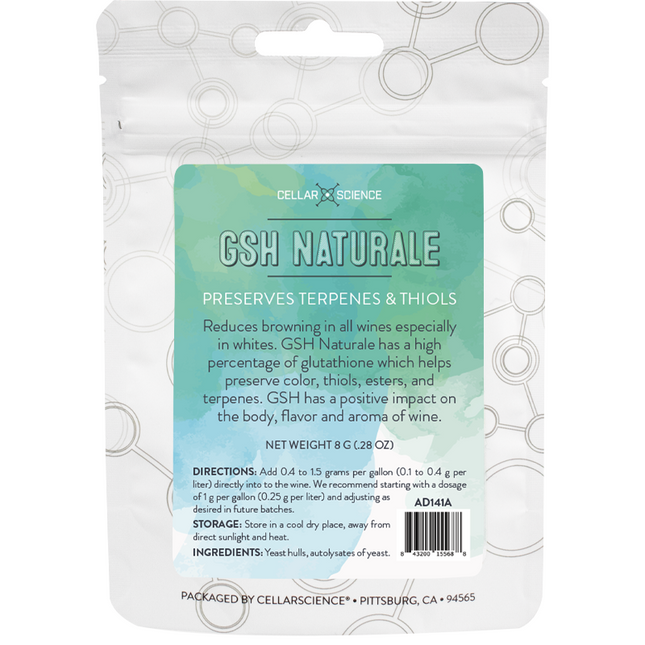
    CellarScience® GSH Naturale | Preserves Terpenes & Thiols

    1 review

    Protects against oxidation Preserves Terpenes, Esters, and Thiols (3MH, 3MHA) during aging Reduces need for SO2 Improves color stability CellarScience GSH Naturale was designed for winemakers who want to take advantage of the benefits of Glutathione. Glutathione reduces browning in all wines but is especially useful in whites. In whites with higher levels of terpenes and thiols (e.g. Sauvignon Blanc and Viognier) GSH helps preserve fruity/floral aromas. It is also particularly helpful to produce natural wines or wines with less SO2. How it Works: Quinones are a class of compounds that can degrade wine by causing oxidizing reactions that lead to browning and the loss of desirable varietal flavors. Terpenes and Thiols are particularly prone to interact with Quinones. Instead GSH reacts with Quiniones creating a stable compound that does not lead to browning and a loss of flavor and aroma. GSH is a natural compound found in yeast cells and acts as a natural anti-oxidant that can be used in conjunction with SO2 or by itself in the case where the winemaker chooses to use low or zero quantities of SO2. GSH Naturale contains a high percentage of tripeptide glutathione along with other polysaccharides that have a positive impact on body, flavor, aroma. Usually used in conjunction with SO2 as an additional natural inhibitor of browning, GSH Naturale will have positive impact on color, wine, thiol, esters and terpene content throughout the aging process. Use: Add 0.4 to 1.5 grams per gallon (0.1 to 0.4 g per liter) directly into the wine. We recommend starting with a dosage of 1 g per gallon (0.25 g per liter) and adjusting as desired in future batches.

    $1.99 - $8.99

  • Vinmetrica SC-300 Pro Kit Vinmetrica SC-300 Pro Kit

    Vinmetrica SC-300 SO2, pH & TA Analyzer Pro Kit

    4 reviews

    You asked for it, you got it. Vinmetrica took their best accessories and combined them with the SC-300 SO2 and pH/TA Wine analyzer to improve on one of the best total wine analysis kits out there! The Vinmetrica SC-300 SO2 and pH/TA analyzer has been paired up with the following accessories: The Lab Support Stand Vinmetrica Electrode Holder The Double Burette Clamp Magnetic Stirrer Rinse Bottle A Small Tube of Burette Detergent 25 mL Glass Burette. Now you can measure SO2 and pH/TA quickly and easily so you can focus on what matters, making high quality wines! One lean, mean wine analyzing machine. The SC-300 combines the SO2 detection of the SC-100A and the pH/TA analysis of the SC-200 into one power-packed instrument. It’s built on the same hardware and software as our other two analyzers, so the accuracy is superb. And it’s just as easy to use – The audible buzzer and visual stop light will automatically let you know when you’re tests are done! Because it does not rely on a color change, the SC-300 eliminates the guesswork in Ripper sulfite tests, especially in red wines! Why Choose Vinmetrica’s SC-300? Where else will you find a single, compact instrument that can measure sulfite (SO2), pH and TA (Titratable Acidity) levels throughout the fermentation and aging process? Even in Red Wines! It’s Accurate: SO2: ± 2 ppm Free SO2. TA: ± 0.2 g/L Tartaric acid pH: better than ± 0.02 pH units Quick! – Less than 2 minutes per test! Affordable – About a $1 per test!* Easy to Use – No mystery solutions, pumps or tubing. *SO2 (Sulfite) Tests cost approximately 70¢ / Test (the cost of the reagents per test). If you do a combined pH and TA analysis, the cost of reagents for the pH/TA test is approximately $1.12 / Test. Complete Wine Testing Kit – Includes Everything Needed to Analyze Sulfite (SO2), pH and TA (Titratable Acidity) levels in Your Wines & Musts: SO2 reagents pH/TA reagents Two titration beakers Two 5 mL syringes Two transfer pipettes SO2 electrode pH electrode 25 mL sampling pipette (for SO2) 5 mL sampling pipette (for pH/TA) The SC-300 Operating Manual The SC-300 analyzer gives accurate SO2, pH and TA values. Kit includes everything to perform about 50 sulfite tests and 30 TA tests: both electrodes, all reagents, pipettes, syringe and beaker. A Quick Overview – Wine Analysis Procedures with the SC-300: Easy SO2 Test Attach SO2 electrode, press the power button, change to SO2 mode and press enter. Draw up 5 mL of titrant into the syringe and place 25 mL of wine in beaker. Add ~2 mL of the acidifier and ~2 mL of the reactant to wine. Place and hold the SO2 electrode in the wine sample and swirl beaker. Add titrant from syringe dropwise until 15 second long endpoint signal reached. Multiply the titration volume by 20, the SO2 conversion factor, results in ppm Free SO2. Simple pH Test Attach the pH electrode, set aside storage solution, rinse with DI water and blot gently with a paper towel. Press the power button then press the ‘Mode’ button and switch the SC-200 into ‘Cal’ mode. Calibrate using the pH 4 and pH 7 reference standards provided. Put the SC-200 in pH mode. Take 5 mL sample of wine, place in a beaker. Take a pH reading. Accurate TA Test For TA test, withdraw 5 mL of the TA Titrant with the syringe. Take 5 mL wine sample and add ~15 mL of deionized water. Put SC-200 into TA mode, place clean pH electrode gently in solution. Add TA Titrant from the syringe dropwise until the endpoint is reached indicated with the visual and audible signals. Record the volume (in mL) of titrant used. Multiply the titrantion volume by 2, the TA conversion factor, results in g/L Tartaric Acid. Vinmetrica Troubleshooting Guide

    $891.00

  • 2.25L Antique Green Bordeaux Farro Glass Wine Bottles, Punted - Case of 6 - PLACEHOLDER 2.25L Antique Green Bordeaux Farro Glass Wine Bottles, Punted - Case of 6 - PLACEHOLDER

    Farro Glass Premium "Marie Jeanne" Triple Wine Bottle | Bordeaux | Antique Green | 2.25L | Case of 6

    Large format Marie Jeanne wine bottle with the same capacity as 3 standard bottles of wine; also referred to as a Tregnum or Tappit Hen bottle No special closure needed; takes standard corks Originating from the Bordeaux region of France, this is the most popular wine bottle shape in the world Antique green glass color is often preferred for red wines to protect them from light during long term storage Farro Glass offers a full lineup of the most essential and commonly used bottles in winemaking The most popular wine bottle in the world. As the name suggests, the Bordeaux bottle (also known as a Claret bottle) originates from the Bordeaux region of France. Easily identified by its wide shoulders and straight body, this bottle style comes in a variety of colors and is suitable for a myriad of wine styles. Brown and dark green are commonly used for reds to protect them from light during long storage periods, while light green and flint are most often used only for white wines that will be consumed much sooner after bottling. This large format 2.25 liter bottle holds the equivalent volume of 3 standard bottles of wine. Volume: 2.25L Style: Bordeaux / Claret Use: Sangiovese, Tempranillo, Merlot Color: Antique Green Finish: Cork Neck Opening: 18.5 mm Bottom: Punted Case QTY: 6 Pallet QTY: 82 Cases Our Farro Glass Wine Bottles offers a full lineup of the most essential and commonly used bottles in winemaking. We scoured the world to find a bottle source that could provide a quality product consistently and at a fair price that we can pass on to our customers. If you've been searching for reasonably priced bottles that are reliably in stock, look no further.

    $41.99 - $2,459.99

  • Encapsulated Wine Yeast - ProElif QA23 (83 g)

    ProElif QA23 Encapsulated Wine Yeast (83 g)

    2 reviews

    ProElif QA23 is a double encapsulated yeast product developed by Proenol for secondary fermentations. The yeast cells are double encapsulated in an alginate bead. The beads can be directly inoculated into the bottle (eliminating the need to prepare a starter culture). This helps ensure control of the number of cells per bottle. Upon fermentation completion, the beads have a greater density than the wine and will quickly drop to the neck of the bottle when inverted. The beads accumulate more tightly than traditional riddling, therefore less wine is lost during disgorging. Traditional freezing and disgorging methods are used to finish the process. The use of ProElif QA23 results in a fresh sparkling wine. If greater yeast character is desired, you may make changes to the base wine with this in mind. For example, ProElif QA23 has been used with Opti-WHITE treated base wine with good results. The base wine must be stable to avoid agglomeration of the beads which could cause subsequent difficulty during disgorging. All of these parameters act in synergy with one another. It is critical to manage them together. If one parameter is over the limit, try to compensate with the others or ferment at a higher temperature. Use at a rate of 2g/L.  For full directions see the handout in the documents tab above.    FOR PROELIF QA23 TO BE SUCCESSFUL, THE BASE WINE SHOULD FALL WITHIN THESE PARAMETERS: Alcohol ≤ 11.5% (v/v) Free SO2 ≤ 15 mg/L pH ≥ 3.0 Free Assimilable Nitrogen ≥ 100 mg/L Calcium ≤ 80 mg/L Protein Stability = stable Tartrate Stability = stable Fermentation Temperature >  12°C(54°F)   Recommended Dosage 1.5-2 g/L 1.0-1.5g/750 mL bottle  

    $40.99

  • KegLand Basket Press - 18L / 4.75 Gal KegLand Basket Press - 18L / 4.75 Gal

    KegLand Fruit Press | Wine Press | Wood Basket Press | 18L

    Efficient juice extraction with higher yield Large capacity, presses up to 15 lbs of fruit at once Versatile for various fruits, including apples, grapes, and honeycomb Retains natural flavors with minimal fruit core damage The KegLand basket press features a simple screw mechanism design with an extended hand shank, making it easy to operate with minimal effort. The thickened press plate and large surface area allow for a more thorough press, resulting in a higher juice yield. The press can handle up to 15 lbs of fruit at once, making it an efficient choice for home enthusiasts. Designed for versatility, the press can handle a wide range of fruits such as apples, grapes, and even honeycomb, ensuring natural, pure juice extraction. For optimal results, fruits must be crushed or mashed before pressing. Apples should be crushed into a fine pulp and grapes or other soft fruit must be gently crushed to break the skins before they are further processed with the basket press. See instructions below for assembly step-by-step guide. Basket Volume: 4.75 Gal (18 L) Dimensions: 14.5" x 14.5" x 21" Empty Weight: 23 lbs Filter bag included KegLand Part Number: KL38119

    $174.99

  • Vinmetrica - SO2 Reactant Solution for MT560 & MT570 - 100 mL

    Vinmetrica - SO2 Reactant Solution for MT560 & MT570 - 100 mL

    2 reviews

    Replenishes the SO2 reactant supplied with the SC-100A, the SC-100 and the SC-300 Analyzer kits. Good for up to 50 tests. Guaranteed for 6 months. To avoid cross-contamination with other reagents, use a dedicated pipette to dispense the SO2 reactant. Store reactant in a dark, cool place with the bottle tightly sealed to maximize shelf life.

    $26.75

  • Caseinate de Potassium (Caseine Soluble) - PLACEHOLDER Caseinate de Potassium (Caseine Soluble) - PLACEHOLDER

    Caseinate de Potassium (Caseine Soluble)

    Caseinate de Potassium, formally Caseine Soluble, is a concentrated, powdered form of Potassium Caseinate produced from milk. Helps eliminate oxidized phenolic (brown colored) and bitter compounds in white wines, rose wines, fruit wines, and meads. Caseinate de Potassium can be used preemptively in the must or as a curative step on finished wine. Recommended Dosage: In Juice: 1.9-3.8 g/gal (500-1000 ppm) In Wine: 0.8-3.8 g/gal (200-1000 ppm) Preparation For Use Add the pre-measured amount of Caseinate de Potassium to 10 times its weight of cold water (do not use juice or wine). Allow the solution to swell for 4 hours Stir to dissolve any lumps When completely dissolved, add the mixture slowly to the juice or wine while stirring continuously (for juice, add Caseinate de Potassium before settling). Once added, strongly stir the entire wine volume to get the Caseinate de Potassium to integrate with the wine. Once Caseinate de Potassium has been dissolved, use the preparation within 2 hours. Minimum contact is 2 days, maximum 15 days. The amount needed for your specific wine is best determined by a bench trial. A rough approximate of weight is 1 tsp = 2.3 grams. We highly recommend using a scale to weigh the product for an accurate dose. We do not recommend relying on these rough conversions for accurate dosage rates.

    $7.99 - $119.99

  • Polycacel - PLACEHOLDER

    Polycacel

    This product replaces our FIN73 - Polylact Polycacel can be used both curatively and preventatively against browning and pinking in white juice or in wine under long term storage conditions. Polycacel helps improve wine color and overall organoleptic properties. A is a blend of polyvinylpolypyrolidone (PVPP), soluble postassium casein and micropulverized cellulose. This specific blend allows for more complete action on phenolic compounds while avoiding over-stripping the wine. To Use: Slowly mix Polycacel in 20 times its weight in cold water (do not use juice or wine). Allow the mixture to stand for 2 hours. For enhanced homogenization, gradually add the Polycacel to the wine container while mixing. Dosages: To protect from oxidation, add to wine and mix thoroughly: 150-300 ppm To treat oxidized juice, add during cold settling: 300-700 ppm  

    $5.99 - $419.99

Frequently Asked Questions

Wine Making Collection Article +

MoreWine! Guide to Red Winemaking Written By: Shea AJ Comfort Download print friendly version Goal of this Manual: To make Great wine at home on your first try It is highly recommended that this paper be read through completely before you start to make your wine. Wine-making is made up of a series of consecutive steps which build on and directly affect each other from the very beginning to the very end. In order to make the best wine possible you will need to make the best decisions possible at each of these steps, and in order to do that, you will need to have a general understanding of the overall process as a whole. Introduction Hello, and welcome to MoreWine!‟s Guide to Red Winemaking. We‟re excited that you‟re interested in learning to make wine, and we‟re hoping that you‟re at least as excited about the idea as we are! We think that you‟ll find winemaking to be at the same time relaxing and invigorating, rewarding and taxing, and a practically limitless source of entertainment and learning. Winemaking has the ability to teach us not only about the world around us, but about ourselves as well. Winemaking is certainly a very old and established activity, the roots of which go back thousands of years. Over the history of the practice, many great texts have been written outlining the process and giving direction to generation after generation of winemaker. Today is no different; there are currently quite a few great books about winemaking available on the market. The purpose of this booklet is not to take the place of a more complete text, so much as to give the new winemaker a more digestible place to start from. The basic process for making red wine is pretty straightforward. Fresh grapes are first crushed and separated from the stems. Next the mixture of juice and solids (called must) is allowed to ferment with yeast, converting the sugar from the fruit to alcohol and carbon dioxide, and extracting the color from the grape skins. As fermentation progresses, the carbon dioxide that is being created pushes the grape skins to the top of the container forming a “cap” on top of the fermenting wine, which must be re-submerged (called punching the cap) frequently in order to continue extracting color and to prevent the cap from spoiling. Once fermentation is completed, the wine is separated from the grape solids in a wine press and set aside for aging. Over about the next year the wine will be allowed to age and develop its flavors. Over the course of this year you may choose to add oak, tannins or a variety of other types of additives to the wine to augment or change its flavor. Also, the wine will be transferred to a fresh container periodically (called racking) in order to separate it from the sediments that naturally settle out of the wine during this time. Towards the end of the aging phase you may choose to add a clarifying agent to improve the wine‟s appearance. Clarifying a wine this way is called fining and the additives used to do it are called fining agents. Alternatively, you may choose to filter your wine to clarify it. Finally, based on a variety of factors that we‟ll expand on as you read further, you‟ll decide that the wine is ready to put into bottles. After a short period of recovery from the bottling process, your wine will be ready to drink! While reading through this booklet, there are a few things we‟d like you to keep in mind. The first, and most important, is that there is very little in winemaking that can really be considered a “right” or “wrong” way to approach a problem or procedure. The favorite maxim on this subject is that if you ask 10 winemakers the same question you are likely to get 11 different answers. Another favorite maxim on the subject of winemaking is that it takes a lot of good beer to make great wine – but more on this later (please contact us if you‟re interested in making beer, we can help you with that too!). So, if, with the exception of a few cardinal rules, there is no real right or wrong way to make wine, then why have we dedicated the time and energy to adding yet another booklet on the subject to those already available? The answer is that over the course of many years we have found that certain techniques offer the greatest chances of success, especially to the first-time winemaker. It is only too easy to have something go wrong which spoils a batch and causes the new winemaker to lose interest or inspiration. Our goal with this booklet is to minimize the chance of this happening and maximize the chance of you sticking with this wonderful, rewarding pastime. There will be things in this booklet that contradict what you have read in other books, or have heard from your friends or relatives who already make wine. We want you to understand that neither we nor they are necessarily wrong. The steps and techniques laid out in this booklet are simply what we have found to work best for the majority of our customers after years of experience and feedback. We‟d like to encourage you to experiment with new products and techniques - and to please contact us with any questions you might have about anything that you see in here. We‟d also like to encourage you to start and maintain a winemaking logbook. Keep track of allthe measurements you make regarding sugar, acid and sulfite levels (don‟t worry if you don‟tknow what these things are, we will go over everything!). Record tasting notes and detailed notes about any procedure that you put the wine through, including any changes that you notice as a result of your procedure. Too often we get phone calls from home winemakers that have a question about their wine and we are unable to help out because the winemaker has kept no or very poor records. We really cannot stress enough how important good record-keeping is. Imagine pulling a wine that you made 3 or 4 years ago and just loving it, but not having any records to refer back to about what additives or fining agents you used. Unless you can remember everything you did with the wine 4 years ago, a record book will be the best resource for you if you want to recreate your best wines. Conversely, if you make a wine that has problems or that you just don‟t like very much, a record book is the best way to avoid repeating the mistakes or procedures that led to the bad wine. Finally, a quick word about the format of this booklet: The text is divided into 10 chapters andis designed to take you through the winemaking process in a step-by-step fashion all the way from picking (or picking up) your fruit through to bottling. Each chapter of the booklet covers a particular phase, stage or aspect of the whole winemaking process. What you‟ll find in Chapter Ten is an Expanded Information section which corresponds to each of the other chapters of the booklet. We‟ve set the text up so that you‟ll get the “nuts and bolts” of what you‟re doing at each stage up front. If you wish to learn more about the “why” as opposed to just the “what” of that particular process just flip back to Chapter Ten and find the corresponding section. Our aim here is for you to have a quick reference guide that you can use to know what it is you need to do, as well as the basic theory behind it, all in an easy to navigate package that will stay within an arm‟s reach in the winery for years to come. So, all that said, let‟s get to it! Chapter 1: Preparation Getting ready to make wine Before we can get into the mechanics of making wine, we need to go over the steps required to prepare. 1.1) Source your fruit There are a variety of resources available to home winemakers nationwide when it comes to sourcing fruit. These sources range from the vineyard down the road to a commercial broker of wine grapes. Many home wine and beer making shops maintain a bulletin board where local grape growers can post ads for their fruit. Starting in 2009, MoreWine! has partnered with Peter Brehm and we are now shipping premium California and Washington State fruit directly to your door via UPS! (To learn more about the many benefits of using frozen must and see what‟s available please take a look at the Brehm Fruit Info section of our website). Finally, MoreWine! offers a free online bulletin board that you can find at www.MoreGrapes.com. As much as possible, we encourage you to develop a direct relationship with the grape grower. We suggest this for a couple of reasons. First, a direct relationship often gets you the best price on the fruit and the best chance of getting the fruit again in subsequent seasons. Second, working with the same fruit year after year will give you the best chance to develop as a winemaker, because you will be able to see how different yeasts and additives affect wine made from the same vineyard and also how differences from one growing season to the next can influence the fruit. 1.2) Get your equipment together If this is your first season making wine there are a few different options for you as far as getting equipment together. We suggest, if possible, that you rent the major equipment like a grape crusher and a wine press if you have a local shop that offers these for rental. Many regional winemaking clubs also have group equipment available. If renting or borrowing equipment is not an option for you, you can also try to find the major items you need in used condition either through a local classified ads website like Craigslist or, again, through a local home winemaking club. Be wary of used equipment as the condition of the equipment can be substandard. Check any steel equipment for rust and any rubber parts for cracks or brittleness. These flaws cannot be effectively repaired and so if you find any rust or cracked, brittle rubber these parts must be replaced. This can be difficult if you‟re looking at older equipment as spare or replacement parts may not still be available. Important note about sanitization!: At all stages in the winemaking process any tools and equipment that are going to come into contact with the juice or wine will need to be sanitized. This is done to eliminate spoilage yeast and bacteria that could contaminate our wine and ruin it. Sanitization is done in two steps: 1. Make sure the surface area to be cleaned is free of any dirt, film or grime. If it isn‟t you will need to scrub it off with a sponge or scrub pad and water. Brushes and hoses can be cleaned with a long hose/line brush made for this purpose. Copyright 2008 MoreFlavor!, Inc Page | 7 2. Once the surface is clean it can now be sanitized. This is done by preparing the sanitizer* and pouring, wiping, or swirling to make sure the sanitizer wets all surfaces needing to be sanitized. After a few minutes contact time, rinse the equipment off with fresh, clean water. * We recommend using Star-San (CL26) as your sanitizer, as it is much friendlier and easy to deal with than the traditional SO2 and citric acid solution that is often referred to in many winemaking books. Unlike the SO2 solution, Star-San has no dangerous fumes and is perfectly safe to come into contact with. In fact during our winemaking, often the first step when we begin working is to dunk our hands into a bucket of prepared Star-San! Chapter 2: The Crush (Day 1) We Picked up the Fruit! Ok, so you‟ve purchased some grapes and brought them home. First, examine the fruit and remove any raisined or rotted/molded clusters. Hopefully the grower will have picked the fruit when the sugars are in the correct range (23°-25° ºBrix). You can request this service, so don't be afraid to ask. If the sugars are outside of this range, you will have to address this after the crush. (Either by adding sugar to raise the ºBrix, or by diluting the must to lower the sugars. See section 2.3 A for a full explanation.) *Note: You can measure ºBrix with a refactometer (MT700) or a standard hydrometer (MT310) - just take your reading off of the ºBrix scale and not the Specific Gravity scale. The grower or your source for the grapes should be able to tell you what the ºBrix are because this usually determines when they are picked. 2.1) Crush and De-Stem the Grapes The goal here is to remove as many of the stems as possible (at least 90%), and make sure that all of the berries have been sufficiently split open to allow the yeast to get in and work their magic. They don‟t need to be completely mashed, just cracked. For small amounts, this can be done by hand with a mesh bag. However, for quantities above 50 lbs, you will want to purchase or rent a Crusher-Destemmer. Unwashed grapes are added directly to the top hopper on these machines. The grapes are crushed by the rollers and fall through the grate below into your fermenter. The separated stems are ejected out of the unit by the “destemming bar.” These machines are available in manual and electric versions. The combination of juice, skins, seeds, and pulp that falls into your fermenter is now called “must”. You add yeast to the must to perform fermentation. Red wines are fermented in contact with solid materials from the grape in order to extract the compounds that give the wine its color, body, and depth of flavor and aroma. 2.2) Let’s Clean the Slate – Adding SO2 (Potassium Metabisulfite) One of the keys to a successful fermentation is removing any native wild yeast and bacteria from the must prior to adding your special winemaking yeast. Wild yeast and bacteria can consume sugar from grape juice just as easily as your special yeast can, but generally produce some pretty terrible flavors in the process. In addition, many wild yeasts are less tolerant to high alcohol levels, and may stop fermenting before all of the sugars have been consumed, creating a “stuck” fermentation. If this happens, left-over sugar could be used as a food supply for any spoilage organisms present, and the wine will be compromised. Therefore, sulfite is added immediately after you crush to “clean the slate” of these unwanted guests. The amount used is usually just enough to kill or at least inhibit spoilage organisms, but not enough to bother more sulfite-tolerant, cultured yeast strains that we recommend using. If your grapes are in good condition, free of mold etc., add 50ppm („parts per million‟) of SO2 based on the total volume of the must. If the grapes are not in good condition, add more sulfite to counteract the presence of the mold and bacteria- up to 100ppm. However, be aware that levels of SO2 above 50 ppm will inhibit an MLF (Malolactic Fermentation) if you choose to do one. The 50ppm dosage rate at the time of the crush is usually fine. *Note: The first sulfite addition made during the crush usually becomes entirely “bound-up” by the end of the alcoholic fermentation. During its aging and storage, only the “free” portion of the SO2 addition is actually contributing to the protection of the wine. Therefore, it is important to keep in mind that this first addition isn't part of the sulfite level needed to protect the wine during its storage and aging. For more comprehensive information on SO2, see sections 8.1 and 10.7.  Types of SO2 We recommend SO2 in 2 specific forms for addition to your wine, Potassium Metabisulfite (most common) and Efferbaktol (our favorite). Potassium Metabisulfite is often shortened to “meta” “SO2” “Sulfite”, and comes in a white powder form. It can be dissolved into water and added to the must or finished wine. Our preferred format for sulfite is in the form of effervescent selfdissolving granules called Efferbaktol. SO2 is also available from Campden tablets, which look like aspirin. Campden tablets are made from Sodium Metabisulfite, a less desirable form of SO2. However, they're easily measurable in small doses. Efferbaktol packets: Sizes: Available in 2g (AD503A), 5g (AD504A), and 10g (AD505B) packets. 2g adds 528ppm per gallon, 5g adds 1320ppm per gallon, 10g adds 2640ppm per gallon. To add the right amount of SO2 for your fermenter using Efferbaktol, divide the ppm by your gallons of must to see how many ppm of SO2 will be added: Let's say you have 10 gallons of must. The 2g packet offers 528ppm per gallon; divide 528ppm by 10 gallons to get 52.8ppm, close enough to our desired 50 ppm. To use: Tear the bag open and add directly to the must or wine. Mix thoroughly. Easy and clean. About Efferbaktol: It takes 2.5 grams of product weight to give 1 gram of SO2. So, the 2 gram packet of Efferbaktol actually weighs 5 grams. This is useful to remember when dividing dosages between vessels while using a scale. If the individual dosages are done at the same time, this is not a problem. Once opened, you should quickly use the entire contents of the package because it begins to lose its effectiveness when exposed to moisture in the ambient air. SO2 in Powdered Form: Sizes: Available in 4oz (AD495), or 1lb (AD500) bags 0.33 grams per gallon results in 50ppm. For 10 gallons you would need 3.3 grams of powdered meta-bisulfite. If you do not have a gram scale, ½ teaspoon (level) is about 3.3 grams and adds 50ppm (“total”) to 10 gallons. To use: Dilute the sulfite powder in water or juice until the crystals are completely dissolved and thoroughly mix into the must. Set Aside a Sample for Testing Once you have added sulfite to the crushed grapes the must is protected. You can safely take out about a quart for testing. 2.3 Testing the Must Before you add the yeast, you need to test the must to determine if any additions/corrections are needed. Very rarely will you get a grape that naturally has the required balance of acids, sugars, and pH necessary to create a harmonious wine. When one or more of these elements are out of their ideal ranges, the quality of the wine suffers. Any potential the fruit had to make a nice wine is significantly lowered. However, if we take the time to correct any possible problems and balance the must early on, the quality of the resulting wine will be better maintained. Correcting a must lays the foundation on which the wine will be built. Even slight adjustments can raise a wine from being just good to great. *Note: When making corrections, consider the varietal. Seed/skin to juice ratio varies for each grape. We will only be getting around 3 (Bordeaux) to 3.5 (Zin and Rhône) gallons of finished wine from every 5 gallons of must! This comes out to 60-70% of the must volume. Don’t forget to take this into account when making corrections to the sugar levels or pH/Total Acidity (TA). In addition, most products designed to go into the must should still use the entire must volume to calculate their dosage. This compensates for the portion of the additions that physically bind to the must itself and will not make it into the final wine volume. This includes SO2, enzymes, tannins, oak, Opti-Red, Booster-Rouge and Noblesse. * Common examples of Bordeaux grapes are Cabernet Sauvignon, Cabernet Franc, and Merlot. Rhône varietals include Syrah, Grenache, Mouvèdre, and Pinot Noir. 2.3 A) Test the Sugar: Before making any adjustments, double-check your °Brix after the grapes have been crushed and the must has had a chance to be completely mixed together. There is usually a bit of variation in sugar levels between each and every bunch of grapes that make up the whole volume. Interestingly enough, these differences are not only found in fruit coming from different sections of the same vineyard, but even off of the same vine. Therefore, the only way to get a truly accurate sugar reading for any must is to wait until the fruit has been completely processed and thoroughly mixed together. *Note: Testing the whole must also helps to make the TA and pH testing more accurate as well. (Information on TA and pH and why they are important will be explained shortly) You can measure the sugar level with a hydrometer or a refractometer A hydrometer works by measuring the density of the liquid you're testing compared to water at a certain temperature. Temperature affects density, so it is important to have a sample close to your hydrometer's calibration temperature. If using a hydrometer: make sure to strain the sample of juice to remove any seeds and skins before filling the hydrometer jar. If the solids are left in the sample, these may cause the hydrometer to stick to the side of the jar, compromising the accuracy of the results. Another good technique for getting a clear juice sample is to place the sample in a freezer for 15-20 minutes. Decant off of the sediment that settles out. However, because a Hydrometer works off of the principle of density, and density changes with temperature, you will need to allow the sample to warm back up to 68 be accurate because this is where most hydrometers are calibrated. The hydrometer jar should contain enough sample that the hydrometer is always floating. Wait until it stabilizes and read the number where the top of the liquid meets the scale on the hydrometer. Note: Depending on the temperature of the sample, you should also add or subtract the amount indicated by the thermometer at the bottom of the hydrometer for the greatest amount of accuracy. If using a refractometer, add a drop or two of the juice to the lens and close the flap onto it. This will cause some of the juice to squish out, which is normal. Next, wait 30 seconds for the sample to adjust to the temperature of the refractometer prism. Then, hold it up to the light and look through it to see where the colored bar extends to on the scale. This is your ºBrix reading. When using a refractometer, make sure the glass lens is clean and dry, and reads 0 ºBrix when testing with plain water. If not, adjust/calibrate it with water according to the instructions that came with it. This usually involves turning a knob or a small screw while looking through it until it reads “0”. Once you have gotten a ºBrix reading for the must, record this in your notes and determine if you need to adjust the sugars or not: As mentioned earlier, you want a sugar level of 22°-25° ºBrix for the start of a red wine fermentation. • If your sugar level is lower than 22° ºBrix, we recommend adding sugar to bring it up to the standard level (called chapitalizing the must). This is done with table sugar: 1.5 oz. of table sugar per US gallon of projected liquid raises the ºBrix by 1°. Measure the amount of sugar needed and completely dissolve it into a small quantity of warm water The warm water ensures that the sugar will dissolve completely into the wine. This small amount of water will not be enough to dilute the wine. Alternatively, you can dissolve the sugar directly into the liquid from the must, but depending on how much you are adding, this may be difficult. Mix thoroughly into the must so that the sugar (which is heavier than must) doesn‟t wind up sitting on the bottom of the fermentation vessel. • If your sugars are higher than 25 ºBrix, you may choose to leave the must as is and make a “big” wine. However, depending on your yeast strain, you may get a wine that does not ferment all the way “dry” (less than 1% residual sugar). To avoid this, you can dilute the juice to 22°-25° ºBrix with water. For complete notes on dilution and chapitalization, see section 10.1. If you don‟t have a scale (MT358): 1 tsp of table sugar = 5 grams (.17 oz.) 8.8 tsp of table sugar = 1.5 oz. TA and pH The next two sections deal with testing pH and TA. These are very important elements to monitor during winemaking because they give us an indication of what is going on with the overall balance of the wine. TA measures all of the combined acids in the wine, (there are many different types) and tells you how acidic/tart the wine is. TA is expressed in either %TA or in g/L of Tartaric Acid. For example, a wine‟s TA could be expressed as 0.65% TA or as 6.5g/L TA. These two values are equivalent, and you can easily switch between the two common ways of expressing TA by moving the decimal point one place left or right. We prefer to express TA in of g/L because we feel it is easier to visualize: We are literally saying that the wine has 6.5g of TA per L of wine. The pH is a measure of how these acids balance out against buffering compounds such as Potassium. pH value also indicates how effective the blend of acidic and basic compounds will be at helping to protect the wine. pH is measured in pH units, pH values of less than 7.0 are acidic. The typical pH range for red wines is between 3.5 and 3.8. Let‟s take a look at how these two parameters interact. Assume we have two red wines that each have the same TA, but different pHs, 3.2 and 4.0 respectively. The wine with a pH of 3.2 will have bright fruit flavors, but it will also be thin, acidic and aggressive on the palette. On the other hand, the wine at 4.0 will be softer and rounder than the wine at 3.2, but also less vibrant; the fruit characteristics will flatten out quickly. Ideally, we are after a wine that has the freshness and strong fruit characteristics of the lower pH wine, but with the roundness and approachability of the higher pH one. The key to achieving this lies in making sure the pH of the wine ends up somewhere in the middle of these two extremes, between 3.4-3.65 pH. Vigilant monitoring of your TA and pH will help you achieve this goal. The importance of correctly preparing a sample for both the TA and pH testing: TA and pH are sensitive tests. It is important to properly prepare samples or we may get false results. With red wines, it is best to get a sample of the must and lightly run it through a blender. The blender serves to open the skins and simulates the chemical make-up the juice will attain once fermentation has completed. The blended sample will need to be strained because the grape solids all have a different pH and TA than the juice itself. If they remain in the sample, they can skew the results. We only want to test the final liquid that is free of solids. To achieve this, first strain the blended fruit to get the solids out. A fine mesh bag (Bag10) is great for this. Next, filter the resulting liquid to obtain a clean juice free of particles. (Paper coffee filters pushed into a wine glass are great for this). The resulting clean juice is optimal for TA and pH determinations. Steps to prepare sample: 1. Lightly blend must in a blender 2. Strain blended must through mesh bag into a bowl or jar to remove solids. Lightly squeeze bag if needed until enough sample has been collected: 50-100mL 3. Place coffee filter part way into a wine glass or jar (maybe use rubber band to secure it around the rim to keep it from falling in.) Pour sample into the filter and allow it to drip into the glass/jar: 30-50 mL. Use this sample to do the pH and TA testing on.  2.3 B) Test for the Total Acidity% There are three methods used by the home winemaker to test for acidity: • Method 1 – Basic: Test the must with an acid test kit (W501). • Method 2 – Better: Use a pH meter with our Test Kit (W501). Run the same test using the acid test kit from the first method, only this time stir with the pH meter while titrating until it reads pH 8.2. Use this as the endpoint for the test in place of the color change. Calculate the results by following the acid test kits instructions exactly as in the first method. • Method 3 – Best: Use the Hanna Acidity titrator (MT682). This is a machine that takes 30 seconds to give you a highly accurate TA reading. Great if doing large batches of multiple samples. Used by hundreds of commercial wineries. Once you have tested your TA, you can decide whether it needs adjusting. Keep in mind that that wine chemistry is very complex. Often, the amount of acid we have calculated on paper is not the amount that winds up being the best choice for taste. This is especially true when working with larger acid additions (>.2%TA or 2 g/L). We recommend making ½ of the addition you think is needed, and then test and taste to see if the balance is correct or if the wine still needs more acid. This is definitely one of those times where art and science come together. Ideally, we are looking for the must to be in a range of .60-.90 TA at the start of fermentation. So: • If your acids are in the

Login

Forgot your password?

Don't have an account yet?
Create account